









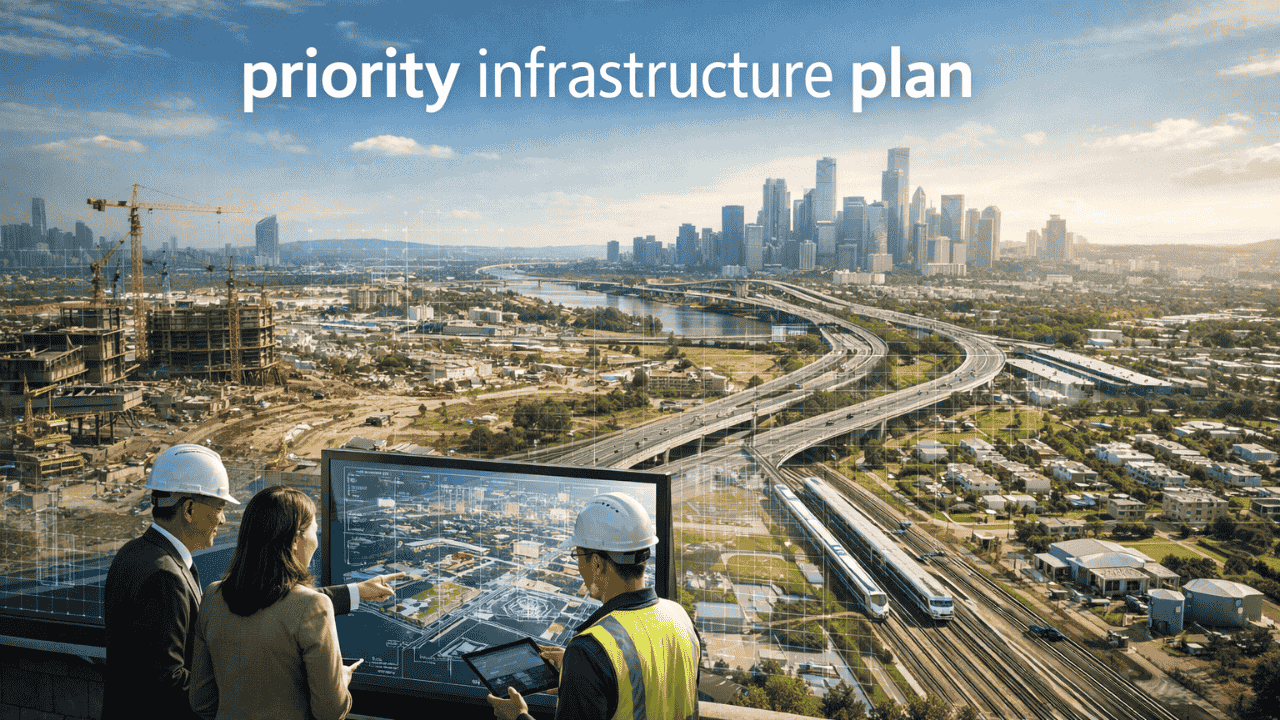
Cities don’t break overnight. They slowly fall apart when roads clog, power fails, water runs short, and public services can’t keep up. That’s what happens when growth moves faster than planning. A priority infrastructure plan exists to stop that from happening by deciding what needs to be built first, not just what can be built. It forces governments and planners to make hard choices instead of chasing everything at once. When done right, it keeps development stable, efficient, and aligned with real needs.
Understanding the idea behind a priority infrastructure plan
A priority infrastructure plan is a structured approach to identifying, ranking, and delivering infrastructure projects based on urgency and impact. It is not a wish list of projects but a filtered set of decisions shaped by limited budgets and long-term goals. Governments use a priority infrastructure plan to ensure that critical systems like transport, energy, and water are developed in the right order. Without this structure, investments often become reactive rather than strategic. The result is wasted money and infrastructure that fails to serve the population properly.
At its core, a priority infrastructure plan answers one simple question: what should be built first to support growth without creating future problems. It considers both current gaps and future demand, making it a forward-looking tool rather than a short-term fix. The process usually involves multiple stakeholders, including planners, economists, engineers, and policymakers. Each brings a different perspective to ensure balanced decision-making. This mix helps prevent one-sided development that ignores real-world consequences.
Why prioritization matters more than construction
Building infrastructure is not the hard part. Choosing what to build first is where most governments struggle. A priority infrastructure plan helps avoid overbuilding in one area while neglecting another. For example, expanding roads without improving public transport often worsens congestion instead of solving it. This kind of imbalance is common in places without a clear priority infrastructure plan.
Prioritization also protects limited budgets from being spread too thin. Instead of funding ten mediocre projects, resources can be directed toward a few high-impact developments. This improves efficiency and delivers visible results faster. It also builds public trust, as people see real improvements rather than unfinished projects. In the long run, this approach reduces maintenance costs and avoids costly corrections.
Key elements that shape a priority infrastructure plan
A well-structured priority infrastructure plan includes several components that guide decision-making and execution. Each part plays a role in ensuring the plan remains realistic and effective over time.
- Project identification based on existing infrastructure gaps
- Ranking systems that evaluate cost, impact, and urgency
- Population and economic growth projections
- Geographic focus areas for development
- Phased timelines for execution
- Funding strategies including public and private investment
These elements work together to create a roadmap rather than a scattered set of projects. Without them, planning becomes inconsistent and heavily influenced by short-term pressures. A priority infrastructure plan keeps decisions grounded in data and long-term thinking.
How growth forecasting shapes infrastructure decisions
Growth forecasting is one of the most critical parts of a priority infrastructure plan. It looks at how populations, industries, and cities are expected to expand over time. Without accurate forecasts, infrastructure can quickly become outdated or insufficient. For instance, building a road for current traffic without considering future growth leads to congestion within a few years.
A priority infrastructure plan uses data such as migration trends, economic activity, and urban expansion patterns. These insights help planners anticipate demand instead of reacting to it. This approach reduces the risk of underbuilding or overbuilding infrastructure. It also ensures that new developments are supported by the right services from the beginning. Planning ahead saves both time and money.
The role of phased development in long-term success
A priority infrastructure plan is not executed all at once. It is divided into phases that spread projects over time based on urgency and feasibility. This phased approach allows governments to manage budgets more effectively and adjust plans as conditions change. It also prevents systems from being overwhelmed by rapid, uncoordinated development.
Short-term phases usually focus on immediate needs like traffic bottlenecks or water shortages. Medium-term plans address expansion and capacity improvements. Long-term phases prepare for future growth and technological changes. This structure ensures that infrastructure evolves alongside the population rather than lagging behind. A priority infrastructure plan creates a clear timeline that guides consistent progress.
Economic impact of a well-executed priority infrastructure plan
Infrastructure is directly tied to economic performance. A priority infrastructure plan ensures that investments generate maximum return by targeting high-impact areas first. Efficient transport systems reduce travel time and logistics costs, making businesses more productive. Reliable energy and water systems support industrial growth and attract investment.
When infrastructure improves, it creates a ripple effect across the economy. Jobs are generated during construction and sustained through improved business activity. Property values often rise in well-planned areas, boosting local revenue. A priority infrastructure plan helps align infrastructure spending with economic goals rather than treating it as isolated development. This alignment is what drives long-term growth.
Social and environmental benefits of structured planning
A priority infrastructure plan is not only about economic gains. It also plays a key role in improving quality of life and protecting the environment. Proper planning ensures access to essential services like healthcare, education, and clean water. It reduces inequality by directing resources to underserved areas instead of concentrating development in already developed zones.
Environmental considerations are increasingly part of modern planning. A priority infrastructure plan can include sustainable practices such as renewable energy, efficient public transport, and green spaces. These choices reduce pollution and improve living conditions. Without structured planning, environmental damage often becomes an afterthought. A balanced approach ensures development does not come at the cost of long-term sustainability.
Common challenges that weaken infrastructure planning
Even the best plans can fail if execution is poor. A priority infrastructure plan often faces several obstacles that limit its effectiveness. These challenges are not technical but structural and political.
- Political influence overriding data-driven decisions
- Budget limitations that delay or cancel projects
- Poor coordination between government departments
- Lack of skilled workforce for implementation
- Short-term policies replacing long-term planning
These issues can derail even a well-designed priority infrastructure plan. Addressing them requires strong governance and accountability. Without that, plans remain on paper while real problems continue to grow.
Sectors typically covered in a priority infrastructure plan
A priority infrastructure plan covers multiple sectors that support both daily life and economic activity. Each sector must be developed in coordination with the others to avoid imbalance.
- Transportation including roads, railways, and ports
- Energy systems such as electricity grids and renewable sources
- Water supply and sanitation networks
- Digital infrastructure like internet and communication systems
- Public services including schools and hospitals
- Urban spaces such as parks and community facilities
When these sectors are planned together, they create a cohesive system rather than isolated developments. A priority infrastructure plan ensures that improvements in one area support growth in others.
Why developing regions need a priority infrastructure plan more urgently
In rapidly growing regions, the absence of planning creates visible strain on infrastructure. Traffic congestion, unreliable utilities, and overcrowded services become part of daily life. A priority infrastructure plan is essential in these areas because resources are limited and demand is rising quickly. Without prioritization, development becomes chaotic and inefficient.
A priority infrastructure plan helps these regions avoid repeating mistakes seen in poorly planned cities. It provides a framework for controlled growth and better resource allocation. This is especially important where urbanization is happening at a fast pace. Planning early prevents costly corrections later.
Conclusion
A priority infrastructure plan is not just a technical document. It is a decision-making tool that shapes how cities grow and function over time. By focusing on what matters most, it prevents waste, improves efficiency, and supports long-term development. Without it, infrastructure investment becomes scattered and reactive, leading to problems that are expensive to fix.
The real strength of a priority infrastructure plan lies in its ability to balance immediate needs with future demands. It forces planners to think ahead while staying grounded in current realities. When executed properly, it creates stable, livable, and economically strong communities. In a world where urban growth is accelerating, having a clear priority infrastructure plan is no longer optional. It is a necessity.
FAQs
- What is a priority infrastructure plan in simple terms?
A priority infrastructure plan is a strategy that helps governments decide which infrastructure projects should be built first based on importance and impact. - Why is a priority infrastructure plan important?
It ensures that limited resources are used efficiently and that critical infrastructure needs are addressed before less urgent projects. - How often is a priority infrastructure plan updated?
Most plans are reviewed every few years to adjust for population growth, economic changes, and new development needs. - What sectors are included in a priority infrastructure plan?
It typically includes transport, energy, water, digital systems, healthcare, education, and public spaces. - Can a priority infrastructure plan help economic growth?
Yes, by improving efficiency, reducing costs, and supporting business activity, it plays a direct role in strengthening the economy.